
Tiny Bubbles
Make me happy, make me feel fine.....

I can’t help it…. whenever I hear the word Bubbles I think of Don Ho. My grandmother loved Hawaii and whenever at her house I would hear the music of the likes of Don, Israel Kamakawiwo’ole, Gabby Pahinui etc.. In fact, trying to play a Ukulele she bought as a wall decoration was the closest I ever came to playing a “guitar” much to the chagrin of my father who was an accomplished picker even on a 12 string.
I have been a little absent from the article writing as I have been trying to get projects done on the ranch before the scorching Texas heat arrived (and it has) and before I began some needed parts replacement on myself which included a new right hip. A buddy told me that I am like the 6 million dollar man with my new parts but unfortunately I put them into a $20 dollar body!
Listening to podcasts while riding around on the tractor or reading a financial post while recovering from surgery I couldn’t escape some mention of the word “Bubble.”
So lets talk bubbles…. According to Lawrence McDonald back in 1999 it was mentioned 6,800 times before the DotCom crash and 6,850 times before the Global Financial Crisis of 2007. Strangely, the best AI could tell me for 2026 is that it has appeared in roughly 50 to 70 major headlines and newsletters. My gut says if I were to include 2025 we are probably as close as 1999. Interesting trivia, but what do we do with that information….
I have followed Jeff deGraaf from Renaissance Macro since his days at Lehman. I think I gravitate towards Jeff’s analysis because 1.) its probability based 2.) it’s usually clear and concise and 3.) he usually defines some tenet where the risk probability changes an expected outcome which is similar to my approach. In a recent podcast Jeff outlined 12 characteristics of Bubbles….
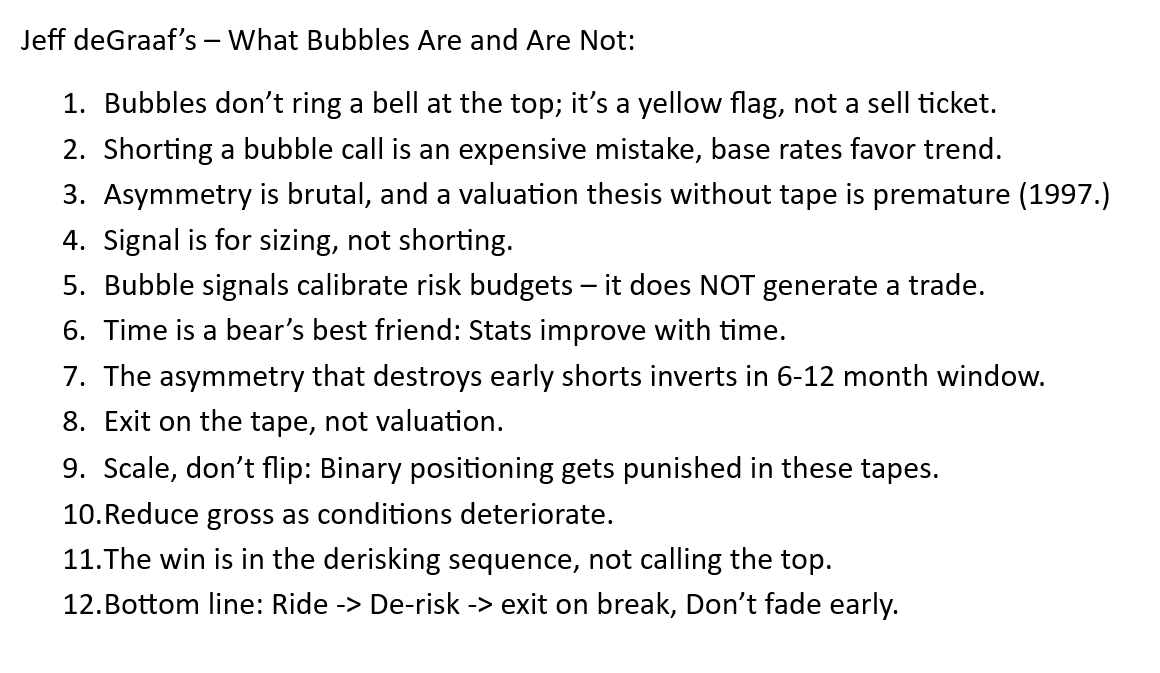
There is some sage advice packed in there and too much for me to cover in a single note but let’s start with #5 - Bubble Signals calibrate risk budgets and #4- Signal is for sizing not shorting . The great Bernadette Murphy once said in a meeting if I recall correctly… Calling tops may be a fools errand but having a clear exit and risk-management strategy is the hallmark of a resilient portfolio. When signals begin to show themselves it is time review the risk management plan and determine now before conditions deteriorate (and emotions become elevated) the signals could potentially change your exposure. That could be adjusting portfolio/system/asset allocations, (however you manage your portfolios,) changing bet sizing etc.. If you have already built your risk management into your trading/investing then a quick wellness check is never a bad idea to confirm or NOT as James Tolkan aka “Stinger” from TopGun said…”“Your ego is writing checks your body can’t cash.”
Am I boldly calling a Top? No, I am not that good…. I am however looking at the weight of the evidence… If I look at my cloudy crystal ball it is telling me that the patient finally has some symptoms of a fever. One of my clues is that some of my trading systems (variations of mean reversion) that were doing well last year are not performing well this year even though the conditions in which those system have historically done well are still in place. Some of those conditions are Earnings & Revenue Surprises (FactSet: For Q1 2026 (with 91% of S&P 500 companies reporting actual results), 84% of S&P 500 companies have reported a positive EPS surprise and 80% of S&P 500 companies has reported a positive revenue surprise.) In previous markets when we had price action like this and the systems waned for more than a quarter - the market corrected more than 13% in the following 90-120 day time frame.
How about trading activity - The Semiconductor group has been on fire. I heard pundits saying this weekend that they are rolling over… Maybe….
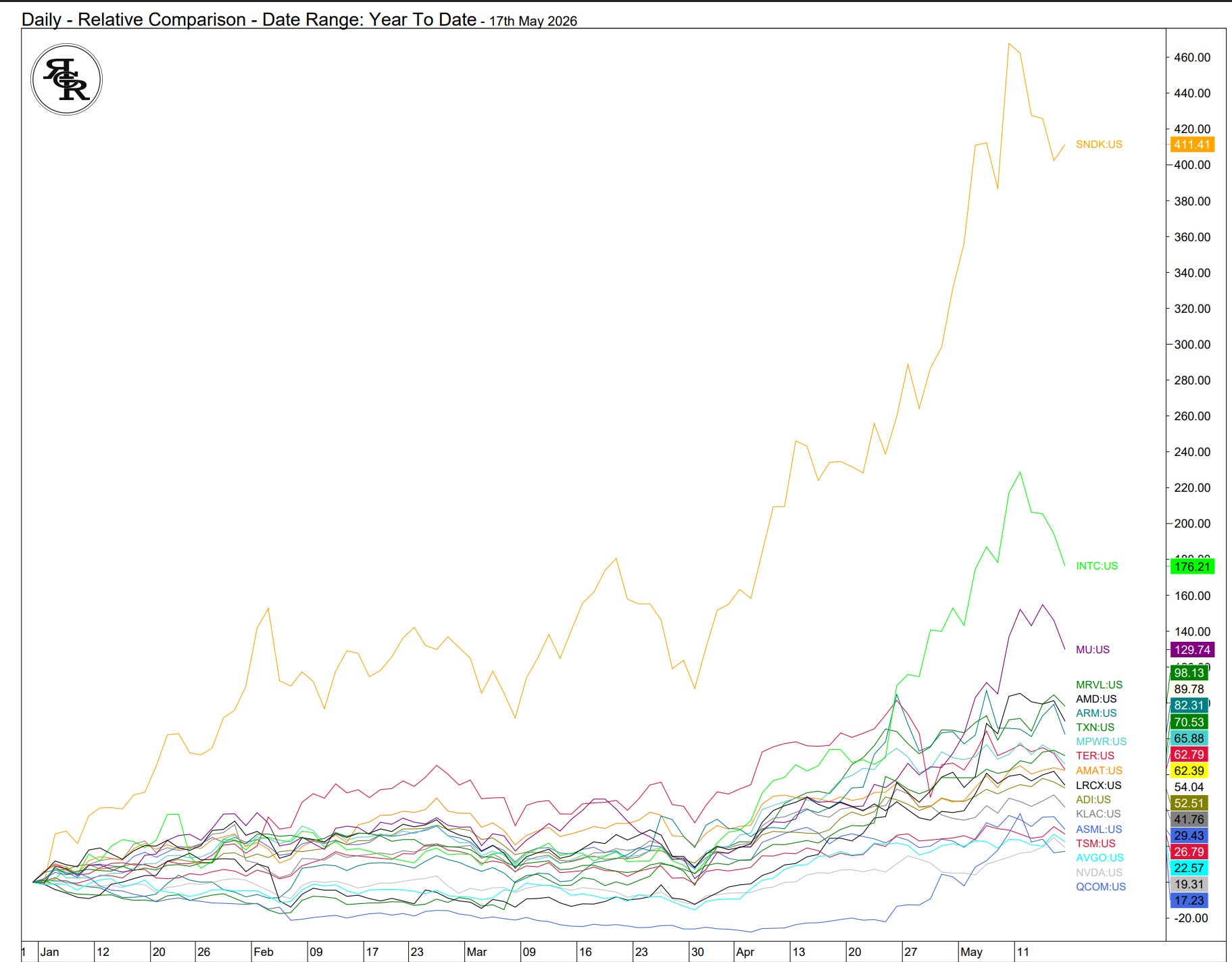
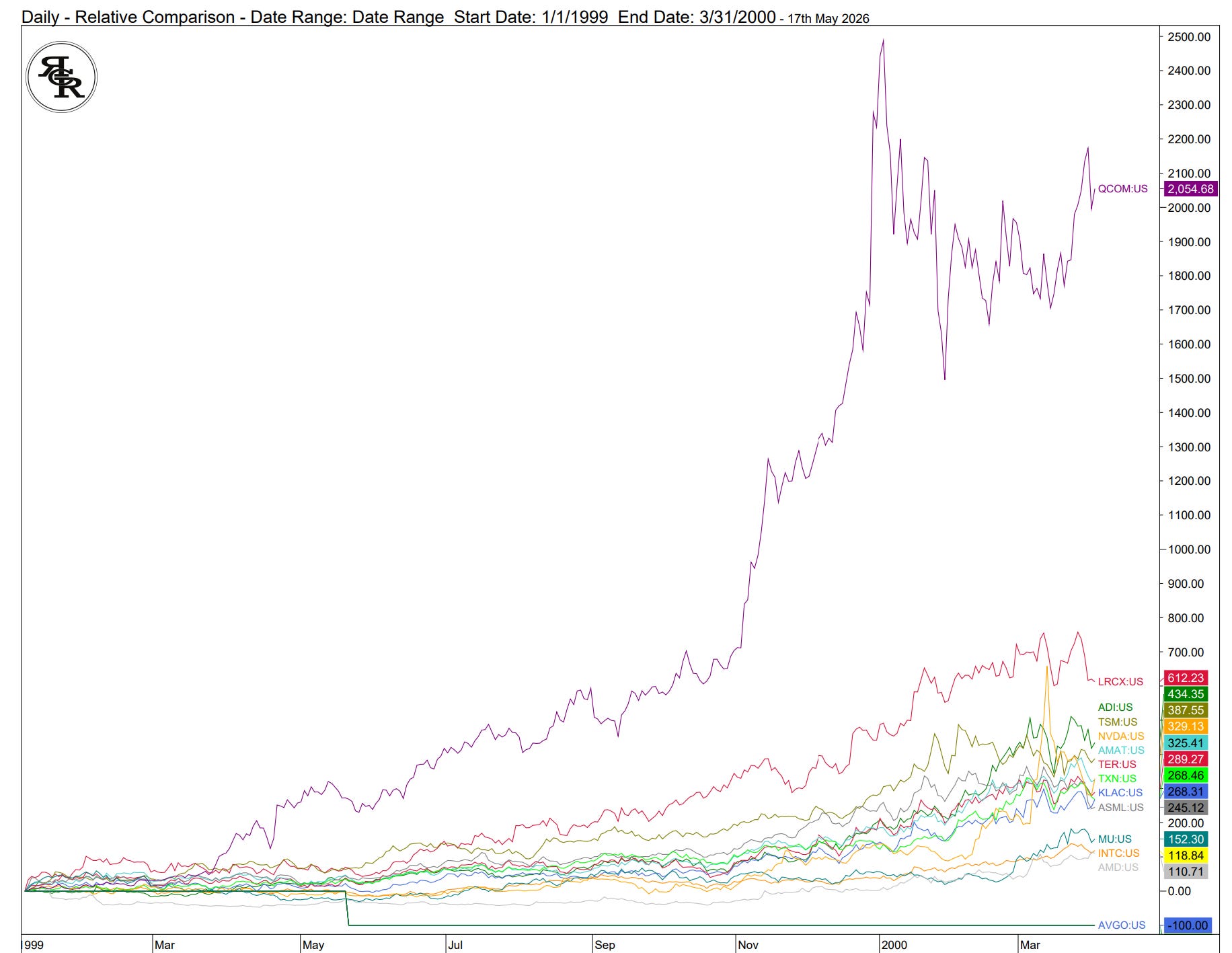
But who is to say that can’t go higher…. Here they were in ‘99 into 2000
This brings us to the # 7 - The asymmetry that destroys early shorts inverts in 6-12 month window and #11 - The win is in the derisking sequence, not calling the top.
If Semi’s do even half as well as they did in 1999 then there is still a lot of meat on the bone. However, if this leadership rolls over and there is nothing rising up to take its place then having a plan (that you have confidence executing) in place can help reduce the noise.
I think Jeff’s #9 - 1. Scale, don’t flip: Binary positioning gets punished in these tapes - is the way to play both the long and the short side. There is not asymmetric risk yet on the shorts. Yes, if something is breaking down in the market - the market is punishing it beyond the normal range (Factset: Companies that have reported negative earnings surprises for Q1 2026 have seen an average price decrease of 4.9% two days before the earnings release through two days after the earnings. This percentage decrease is much larger than the 5-year average price decrease of 2.9% during this same window for companies reporting negative earnings surprises.) However, until that risk/reward changes scaling some shorts or using some optionality to adjust risk is prudent.
Remember #8 - Exit on the tape, not valuation.